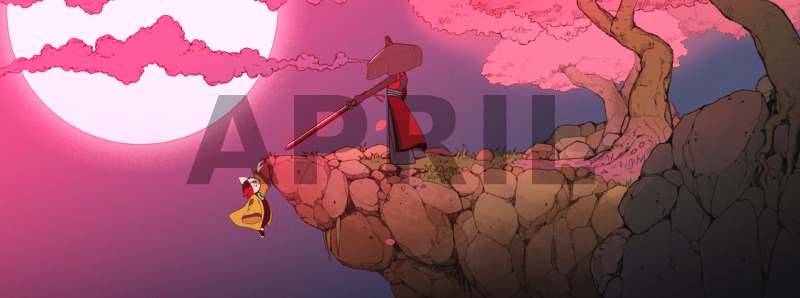
Cover photo from Nine Sols.
Hope you all had a nice April. I briefly considered penning a fake, glowing review for some total piece of garbage like Big Rigs : Over the Road Racing or I dunno, League of Legends as an April Fools prank but given that it’s now May and the fact that nobody really seems to like April Fool’s Day shenanigans anymore anyways, I quickly decided against it. Maybe next year if some really funny concept comes to me. Anyways, onto a game that I can give a glowing, non-satirical review to…
Take one part metroidvania, mix in an Eastern fantasy visual style, and sprinkle with Sekiro-style parry-based combat and voila, you’ve got Red Candle’s excellent Nine Sols. This is a game I’ve been meaning to get to for a while after hearing lots of positive buzz and I’m quite glad that I did.
Red Candle is a Taiwanese studio that you may recognize for their first few games Detention and Devotion. The latter is infamous for being at the center of a scandal in which an asset was discovered in the game that mocked Chinese President Xi Jinping, leading to a wave of review bombing and its subsequent removal from all major stores (to this day, you can only buy it directly from the developer’s website). Controversy aside, both were excellent horror games and lauded by critics. Nine Sols is a hard left turn for the studio into developing a tough-as-nails 2D action game, but I’ve gotta say that you wouldn’t know it’s their first game in the genre because they crushed it. Red Candle made a game that has rocketed to my upper echelon of metroidvanias, landing below only the excellent Hollow Knight : Silksong and the one that arguably started it all, Castlevania: Symphony of the Night.
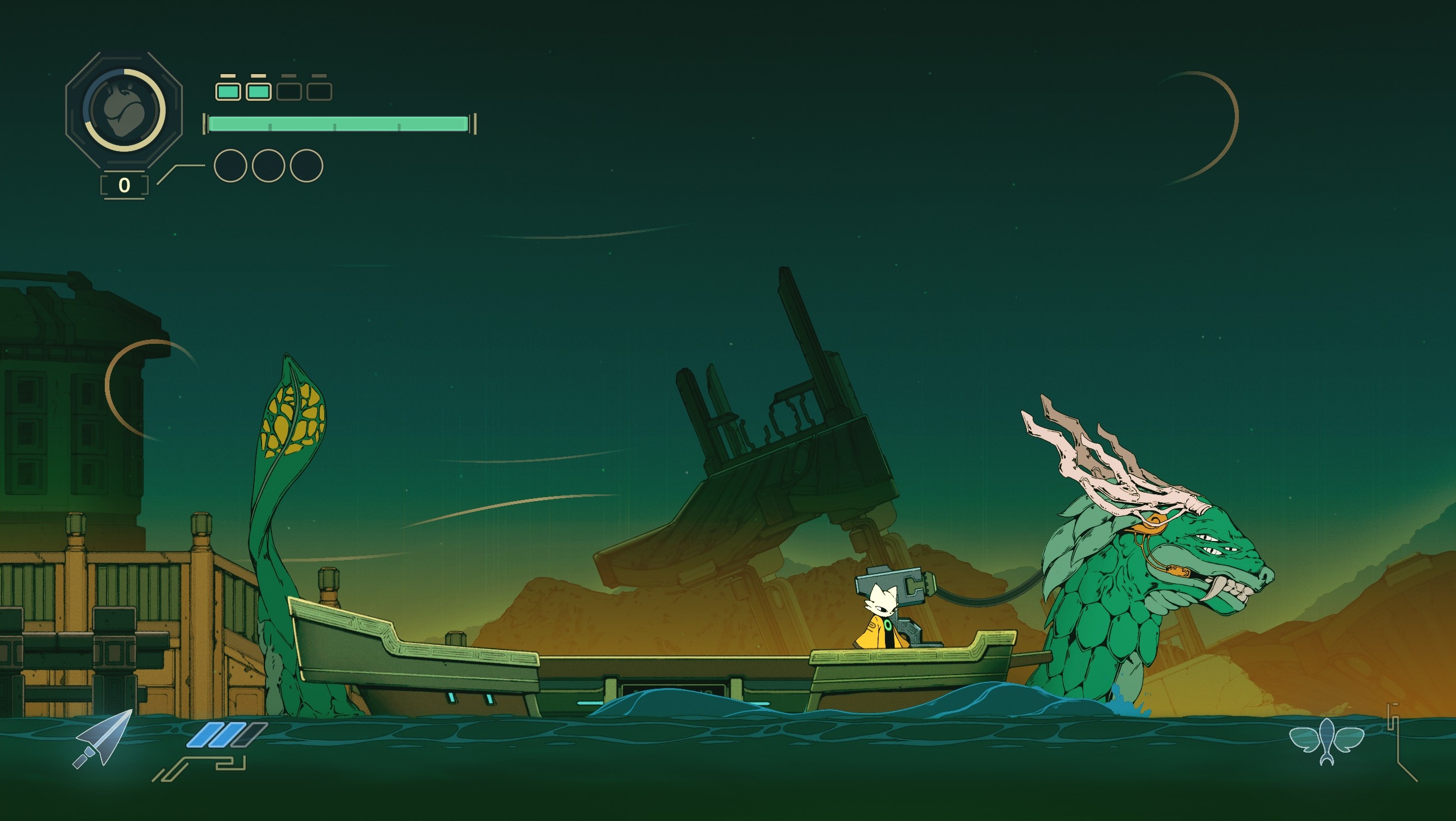
The game begins with the protagonist Yi, our protagonist and small catlike fella, barely hanging on for his life to the edge of a cliff after having lost a duel with his former mentor. Yi’s strength falters and he plunges to his gruesome death at the bottom of the chasm, only to be wrapped up by spectral roots which start to heal and regenerate his body. He is eventually restored to the land of the living, but still needs time to regain his full strength afterwards. He joins a nearby village of humans and develops a bond with a young boy named Shuanshuan, an orphan whose parents were killed years ago as part of a ritual sacrifice. Shuanshuan himself is set to go through the same ritual this year, and claims that he’ll get to see his parents after he “ascends,” not knowing the truth behind it. Yi intervenes during the ritual, saving his life, and through this gains access to the strange mechanical tunnels below the village. Not all is as it seems, our hero is much more than meets the eye, and he has unfinished business deep within this labyrinth. Eventually he’ll make a number of allies and meet up again with Shuanshuan who has followed him into the facility; soon after Yi will begin unleashing his vengeance upon the Nine Sols, the council that controls this realm.
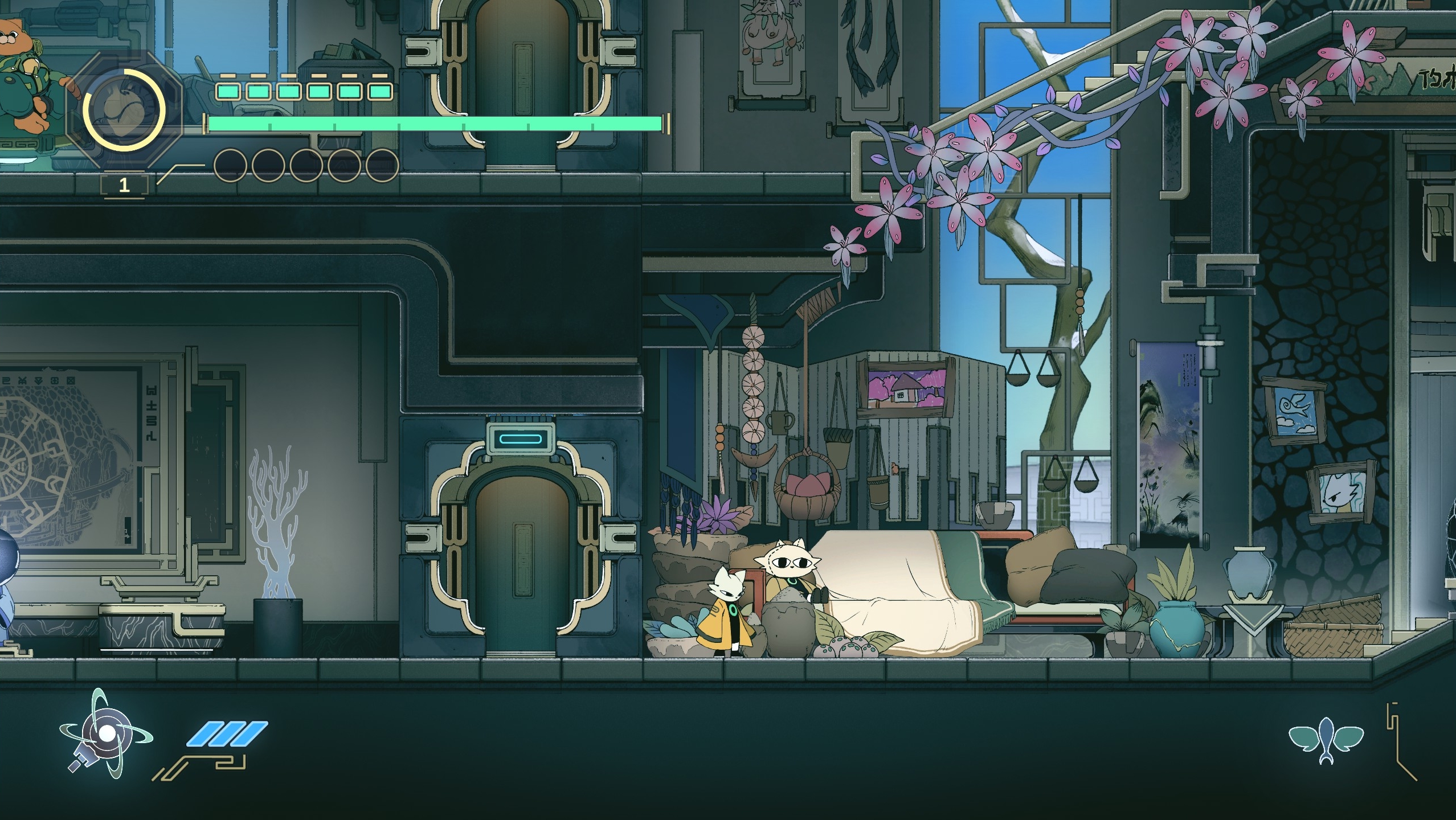
Your main verbs in this game are slashing, dashing, and parrying. The latter is the most important; it grants a Qi charge that can be used to dash through an enemy and apply one or more talismans, which burst for heavy damage. You have some invulnerability frames when dashing, but parrying is the primary way that you mitigate damage and build your Qi meter. I personally still haven’t played Sekiro, but by all indications Nine Sols takes heavy inspiration from its deflection-based combat where learning attack patterns and timing is paramount to success. You’ll likely get knocked around a lot while learning the difficult fights but when the parrying clicks, it feels INCREDIBLY good to execute. I found the parry timing to be fairly forgiving, and even if you don’t parry perfectly you will take temporary damage that regenerates over time (and you still generate Qi from imperfect parries). Once you have a few early mobility upgrades the combat really sings, especially so during the boss battles, all of which are bangers without exception. The final boss in particular is one of the best boss fights I’ve ever experienced in a game of this type, and finally locking in the parry timings made me feel like my brain was expanding to the size of the cosmos. If you like deflection-based combat, it really doesn’t get much better than this. This is a first for this blog, but because I think this game has to be seen in motion to be understood, here’s a recording of me fighting one of the later-game major bosses (minor spoilers ahead, of course). It helps that my winning attempt was clean as hell, one of those instances where you just enter a flow state and completely lock-in.
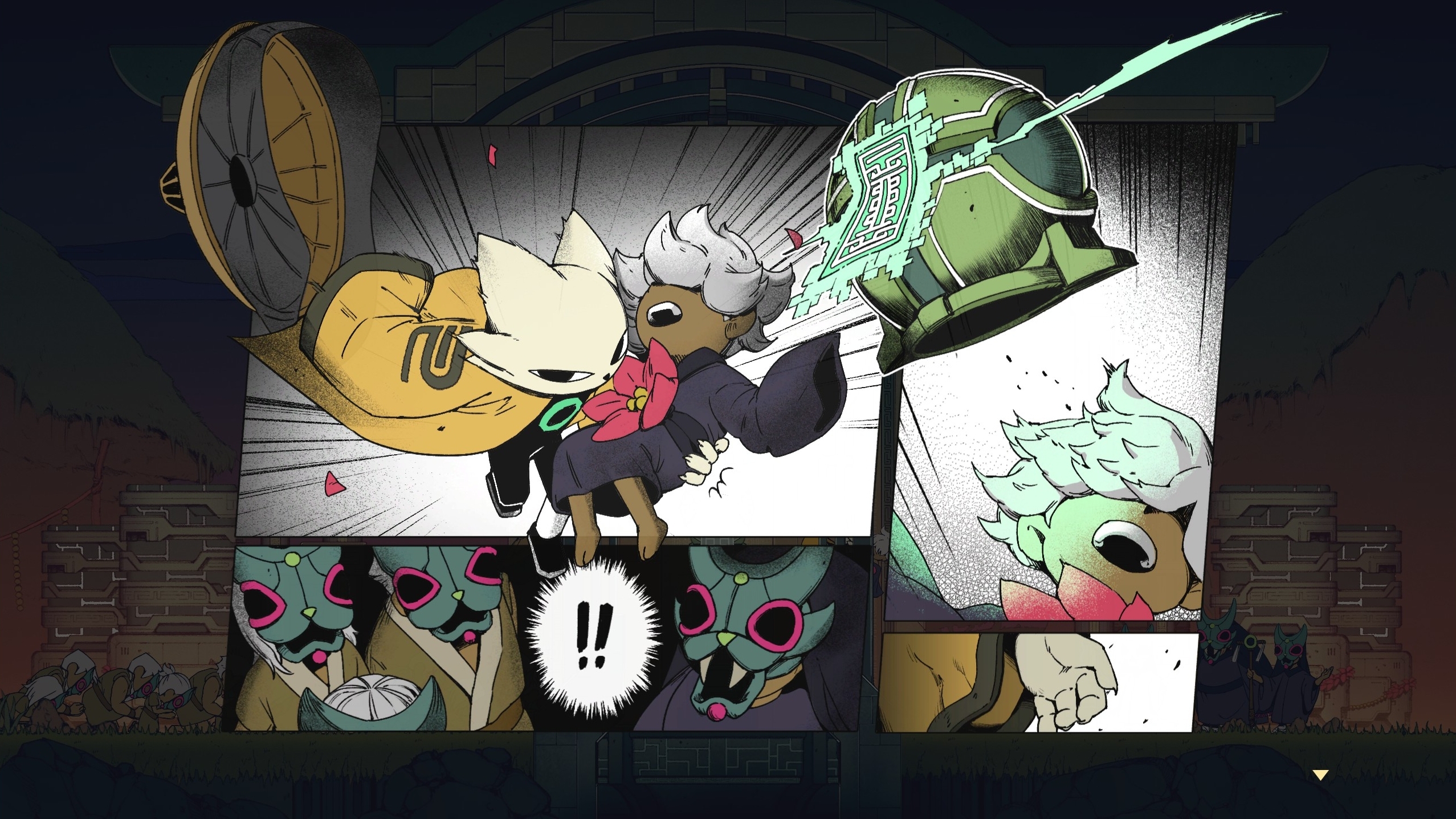
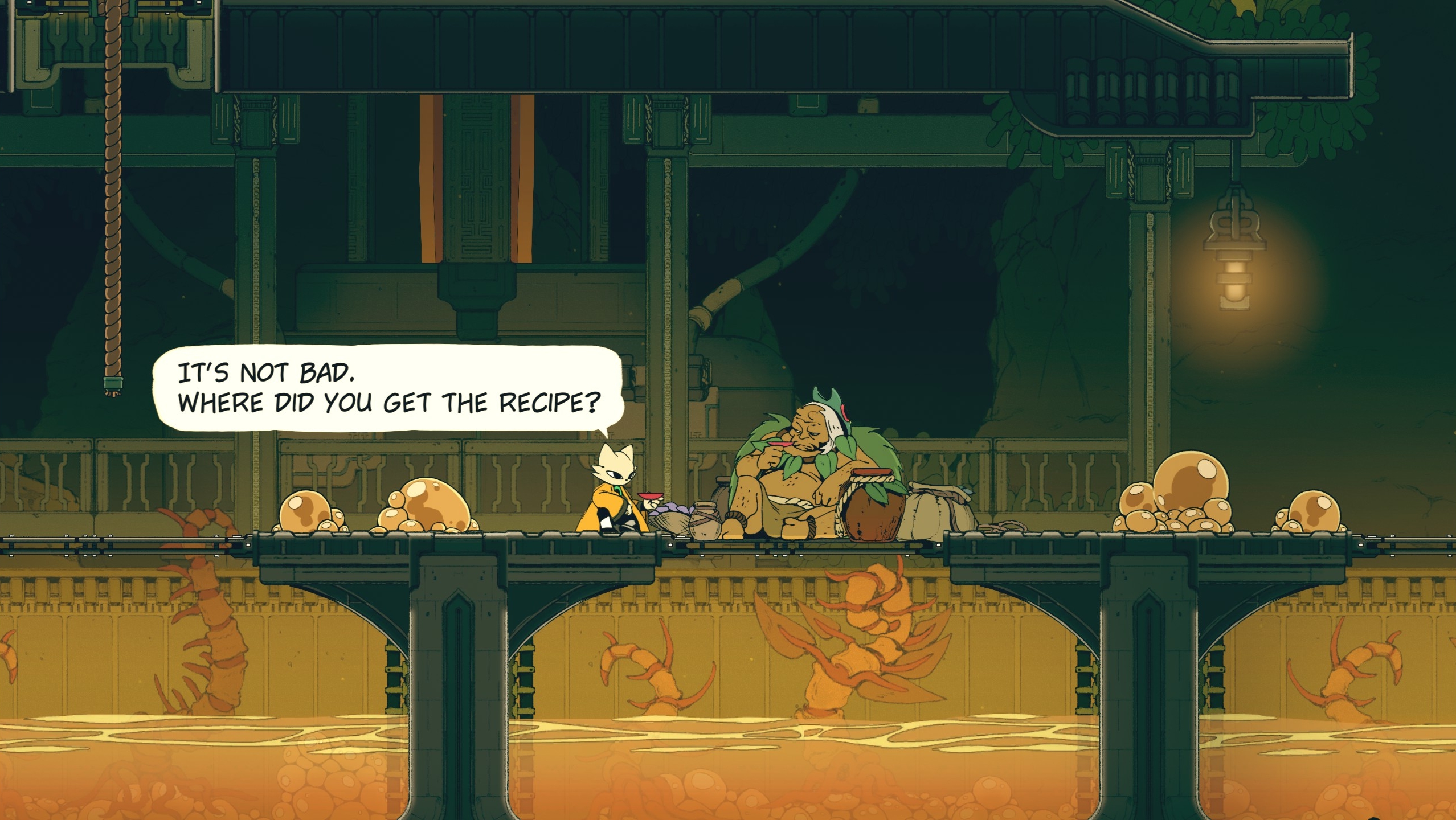
The game is also just gorgeous and so damn charming. The art is colorful and lush, expressing a unique futuristic Taopunk style with gorgeous animations that also serve to clearly telegraph enemy attacks. Eventually you’ll establish a home base where Shuanshuan and your band of misfits will reside while you’re out accomplishing Yi’s mission, and I especially liked the interactions between Yi’s old friend Kuafu (a portly orange cat-man with a boba tea container strapped to his chest) and of course with Shuanshuan, his surrogate younger brother. You can bring back various relics to him you find in the world and it’s adorable to watch him learn and adapt to this bizarre and fantastic new world he finds himself in. During important story scenes I was also delighted to find that many of these parts are depicted as meticulously-illustrated comic panels, all of which feel like they could have been pulled straight of an acclaimed graphic novel.
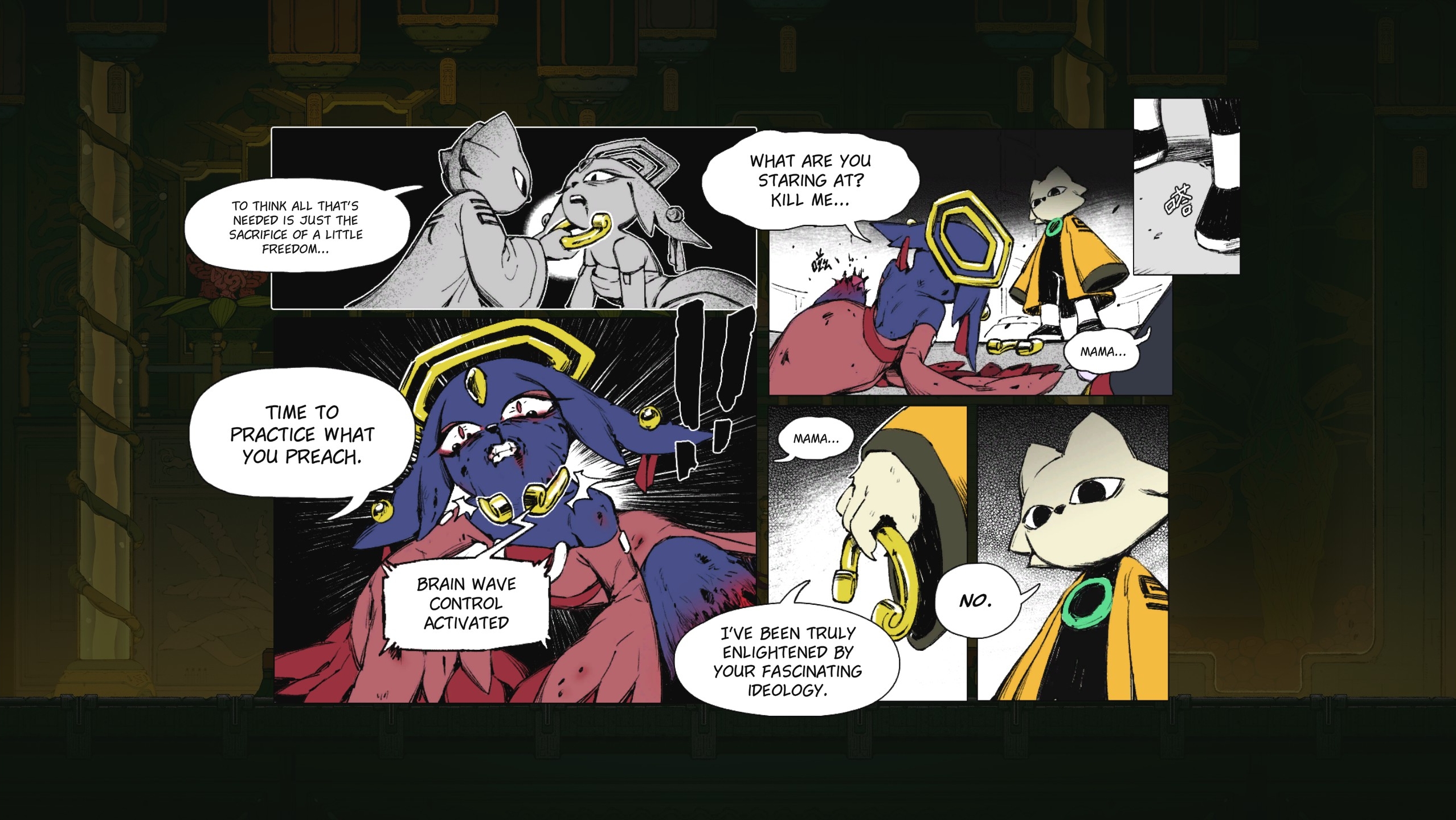
Truly, I believe Nine Sols is a top-tier action game and I’m fascinated to see what Red Candle has in store next. On the standard difficulty it is quite challenging, but it has excellent granular difficulty settings where you can tune damage you inflict and damage done to you from anywhere between 1% and 1000% based on how mellow or sweaty you’re feeling at the time. It comfortably lands in the hallowed grounds of the 90s and comes with a very high recommendation.
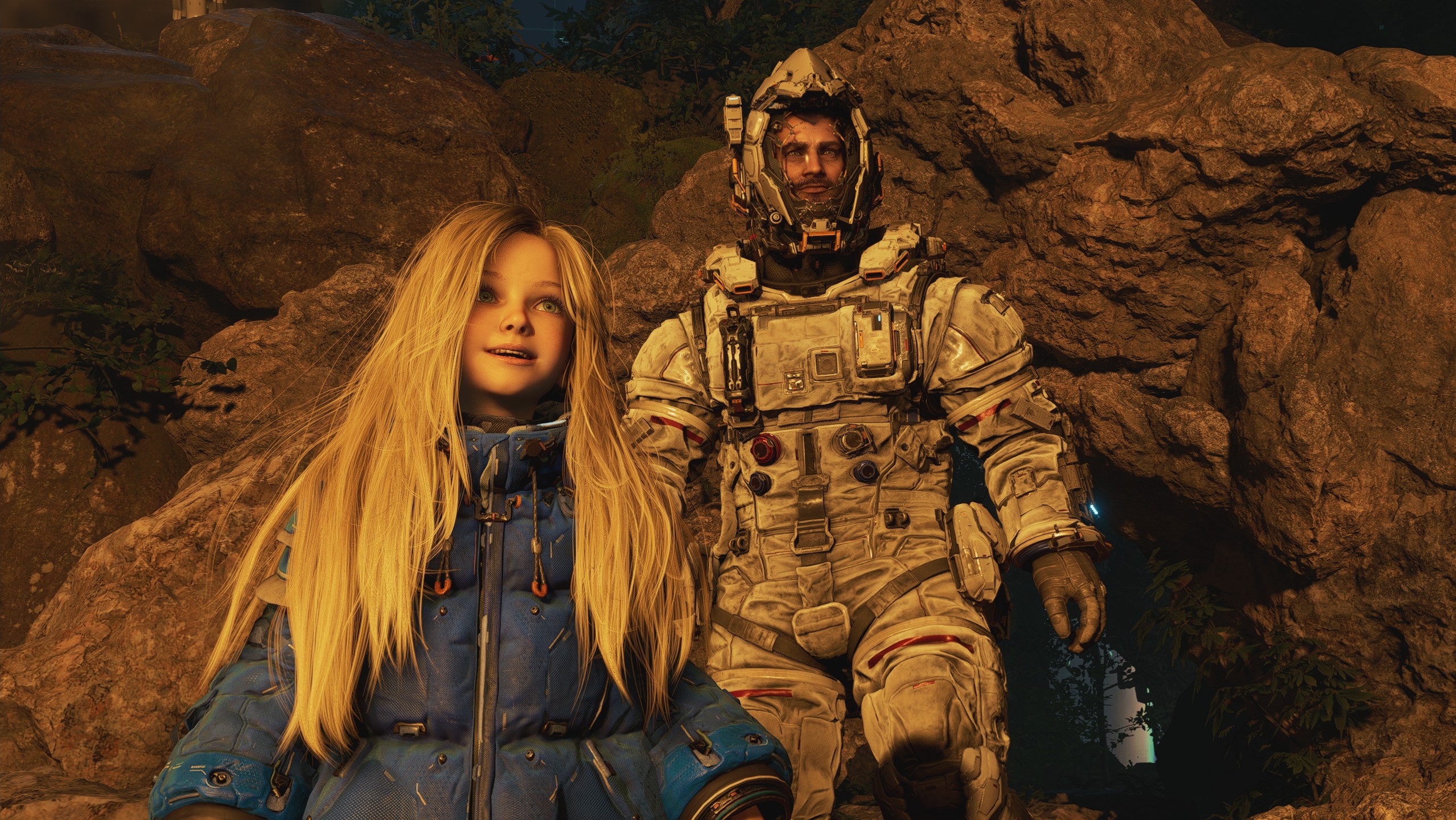
At first I wasn’t sure what to make of Pragmata. I recall seeing the original trailer for it a year or so back and wondering if this was some sort of odd gritty MegaMan spinoff given the bright blue coat worn by the deuteragonist, the pint-sized android Diana. I’m pleased to report that no, this is a wholly original new IP concocted by the wizards at Capcom, a company that is both releasing blockbuster hits as well as more experimental and interesting projects like this.
It begins with a fairly straightforward concept: a moon base called the Cradle has been emitting a distress signal, and engineer Hugh Williams and his team are dispatched from the earth to the moon to find out what went wrong. The Cradle is home to a research facility where a newly-discovered material called Lunafilament is being experimented with, a material that can closely mimic any other type of matter and could change the world. Upon arrival, things quickly go awry with a dramatic moonquake causing the structure they’re in to collapse and the other three members of Hugh’s squad to perish amongst the chaos. He wakes up to his suit being patched by a small android girl who has lost her memory. She rattles off her designation number but Hugh gives her the name Diana, which she enthusiastically takes to. The two team up to survive, combining Hugh’s talent for weaponry with Diana’s natural hacking which makes them a formidable team. Together they take on the rogue AI IDUS which has caused the facility’s bots to go berserk.
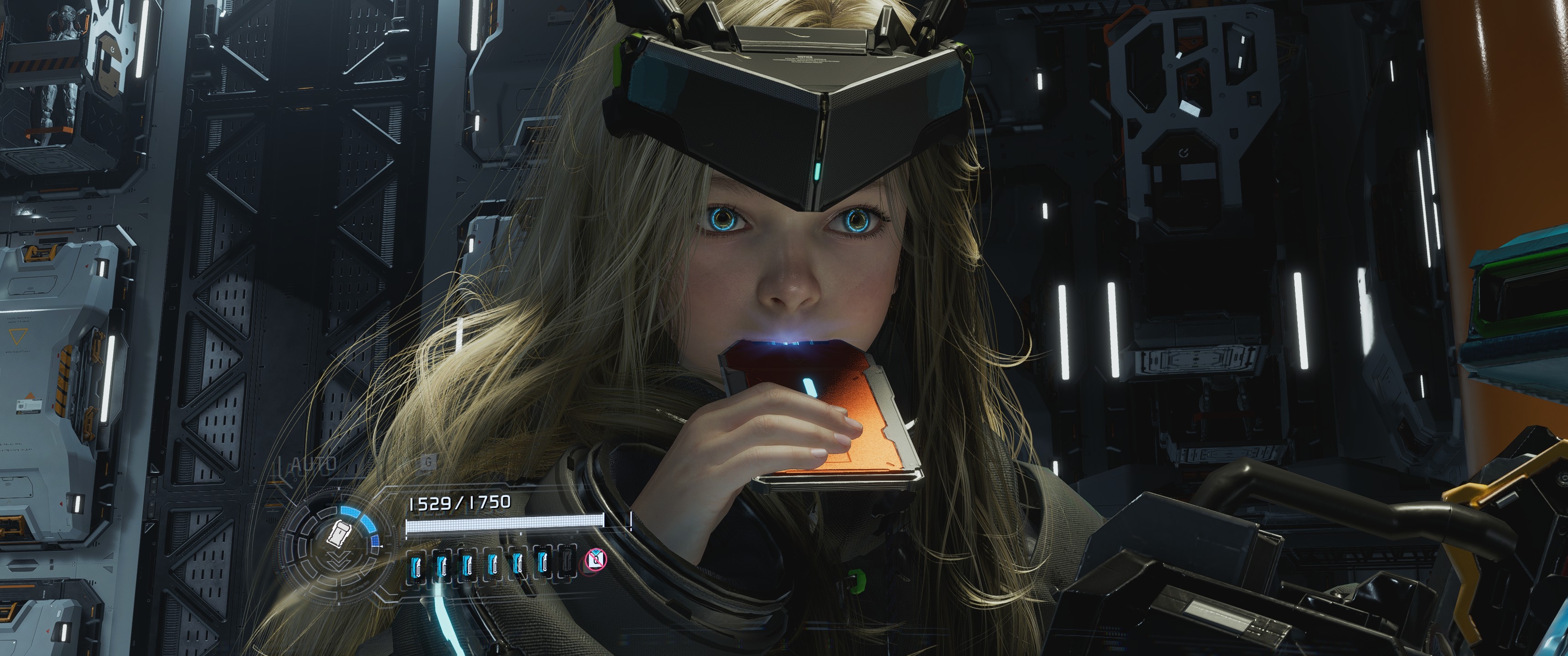
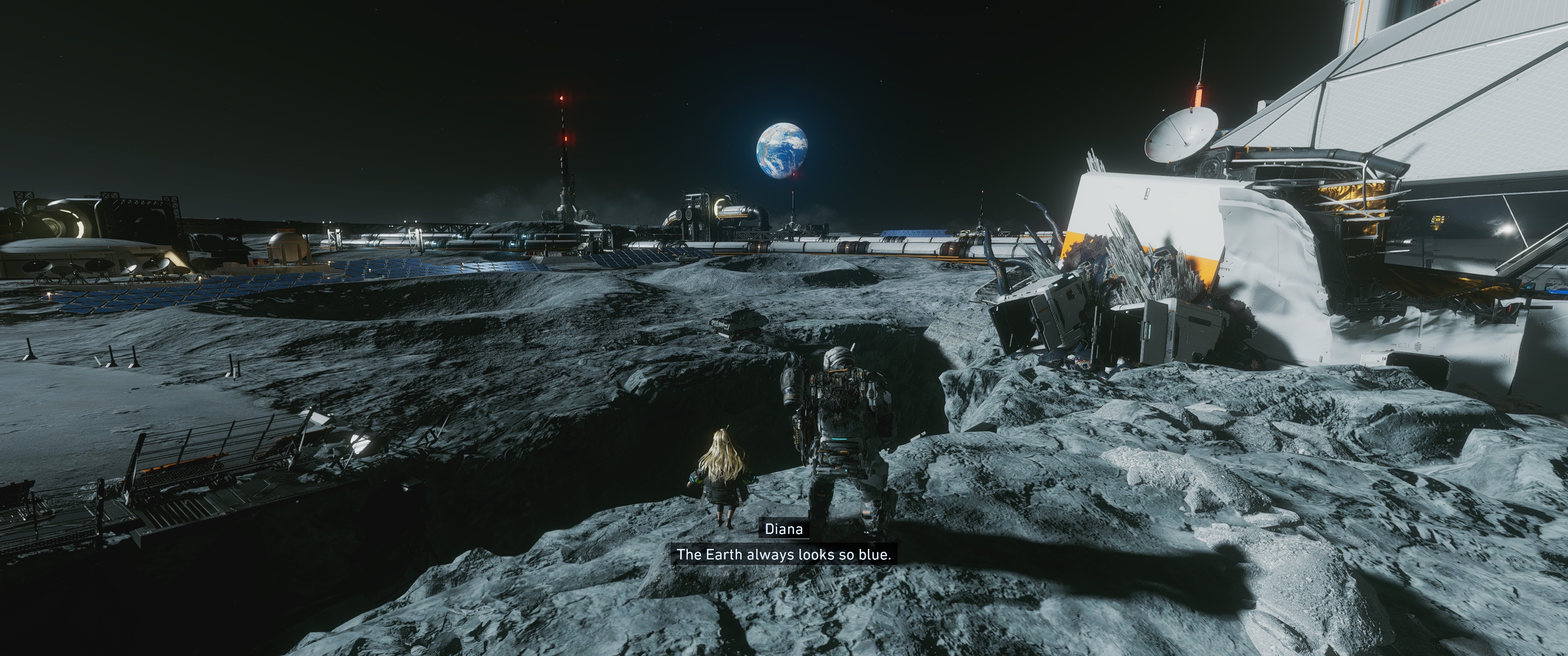
This makes for a combat system which is different from anything I’ve seen before. Aiming Hugh’s weapon with LT also brings up Diana’s hacking grid for the enemy you’re aiming at. Navigating through the grid with the face buttons and connecting nodes to the final green node pops open enemy weakspots and makes them vulnerable for Hugh to blast away at. Eventually you also gain the ability to execute subsequent hacks when the enemy is already open, causing additional damage and/or status effects like overheat, confusion, etc. If you really want a challenge, try doing both at once. Fire off a few rounds with Hugh, hack away with Diana while the weapon cycles, and all the while keep an eye on your surroundings and dodge incoming enemy attacks. All of the modes of play are relatively average for this kind of game, but it’s the synthesis of them and interplay between them that makes for some really unique and engaging gameplay. There are simulation challenges unlocked periodically in the game that are a blast to run through and often teach you more skills and tactics you can apply during the regular game.
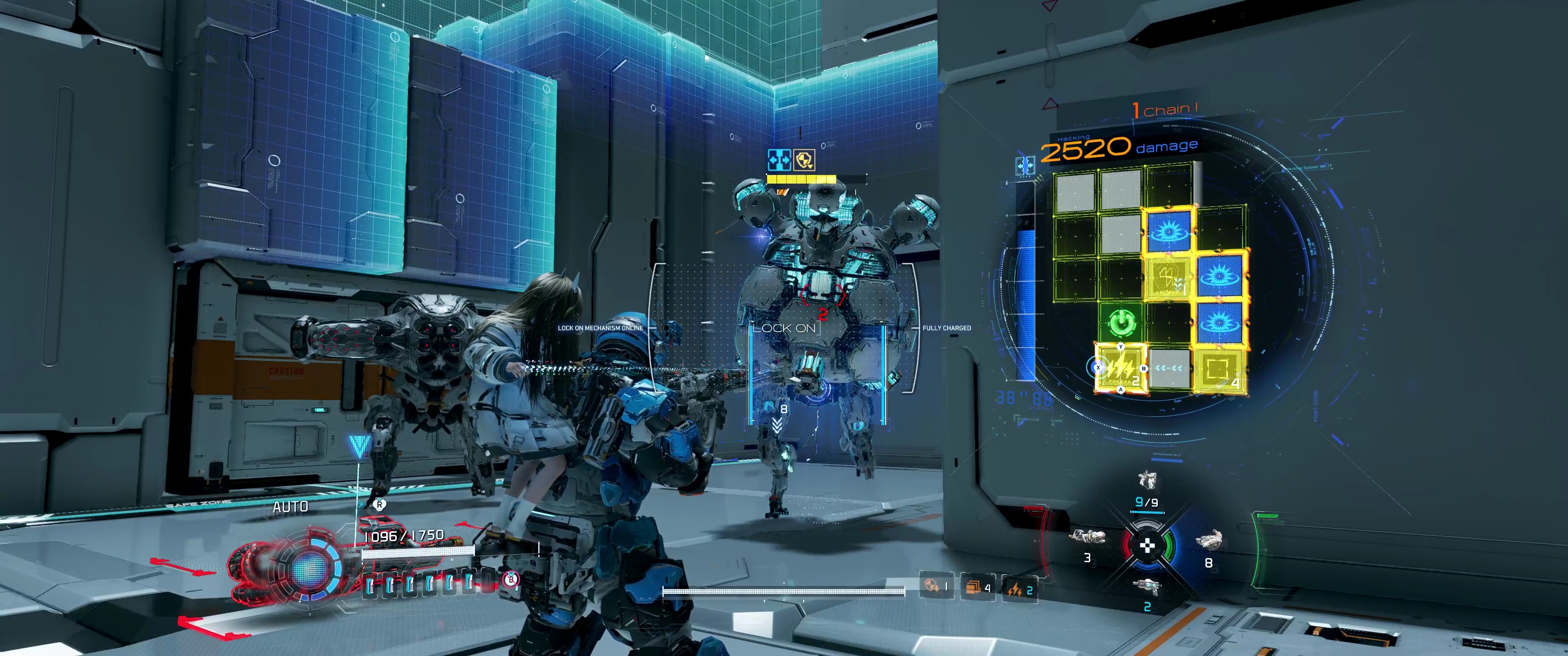
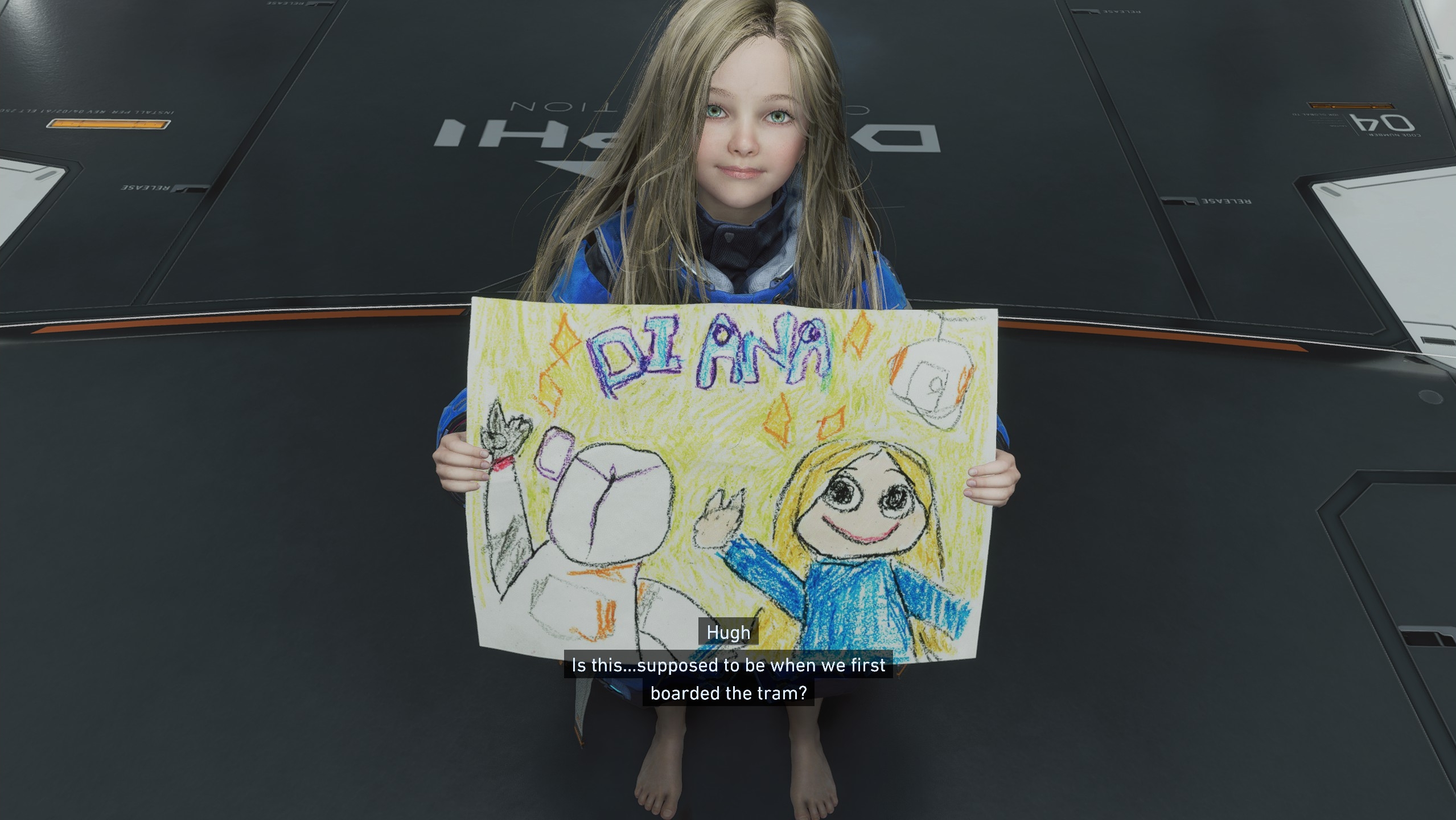
The draw here is definitely the gameplay, but the fantastic technical art for the environment and enemies bears mentioning, and Capcom’s in-house RE Engine shines here, delivering buttery smooth gameplay where it feels great to move through the world and blast bots. I wouldn’t say the game’s plot is groundbreaking, but I do have to give credit for the great characterization of Hugh and Diana and the relationship and trust they build throughout the game. Despite being a highly-advanced android, Diana is very much modeled in appearance and personality on a 6-year-old child and behaves as such. You can find memory modules throughout the game that can be brought back to the shelter hub area to replicate fun objects from earth that Diana can play with. She’ll play and frolic, she’ll bring you adorable crayon drawings, and I couldn’t help but smile. Hugh’s voice actor brings some very “gee golly” midwest uncle energy which is sometimes at odds with the tone of the game, but mostly works. There’s definitely a theme of found family here; Hugh eventually confides to Diana that he was adopted and it’s clear to see partway through the game that the amnesiac Diana comes to see him as a surrogate parent in turn.
By all accounts Pragmata has received positive critical acclaim and seems to be selling well. I would love to see Capcom return to this universe and have another bite at the apple. This game is great as it is, and I think a proper sequel could end up being something really special. I say we’ve seen enough Sad Dad games, give me more Rad Dad games like this.
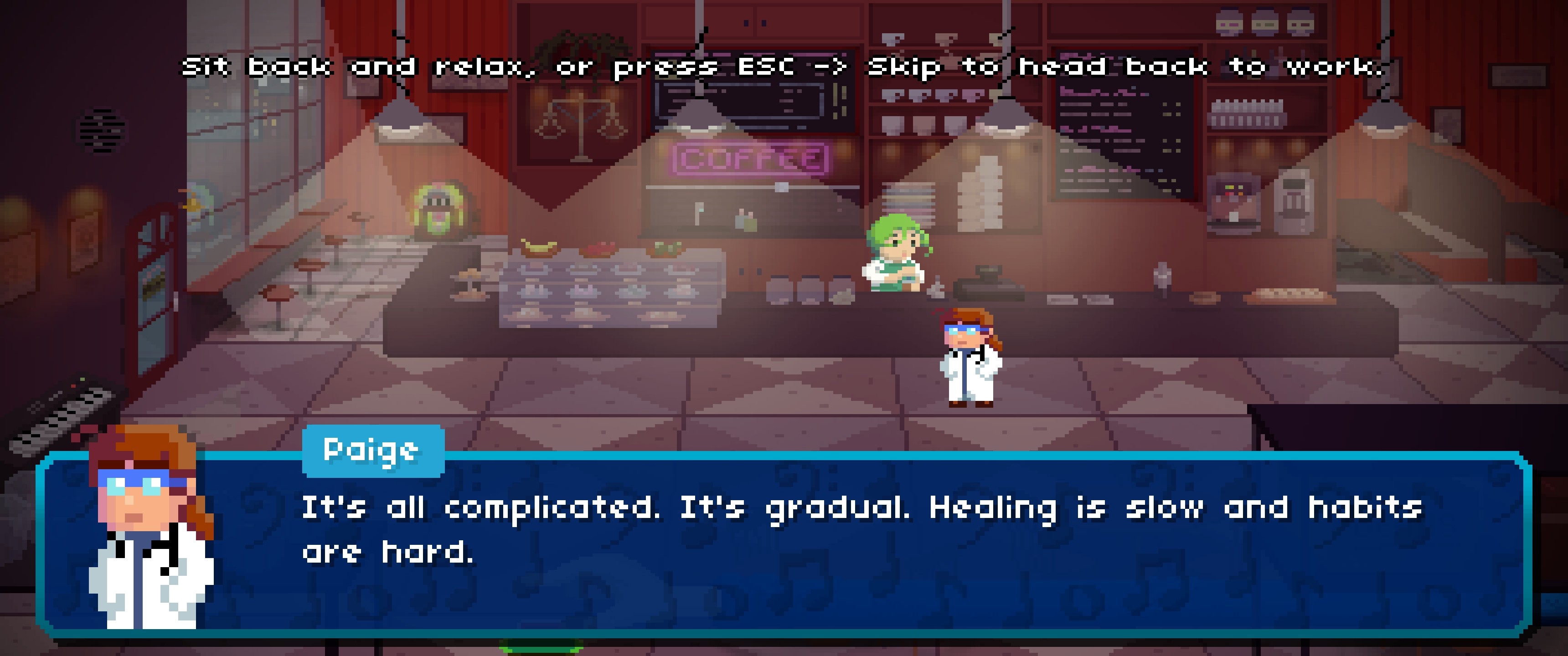
I have always loved rhythm games. In my teens and early 20s I always loved playing Dance Dance Revolution as well as the more gimmicky music games that used specialized controllers like Beatmania, Taiko Drum Master, and of course the Guitar Hero and Rock Band games. So all of that having been said, I’m disappointed to have to turn in a mixed review of Rhythm Doctor, a music game with a unique one-button gameplay gimmick.
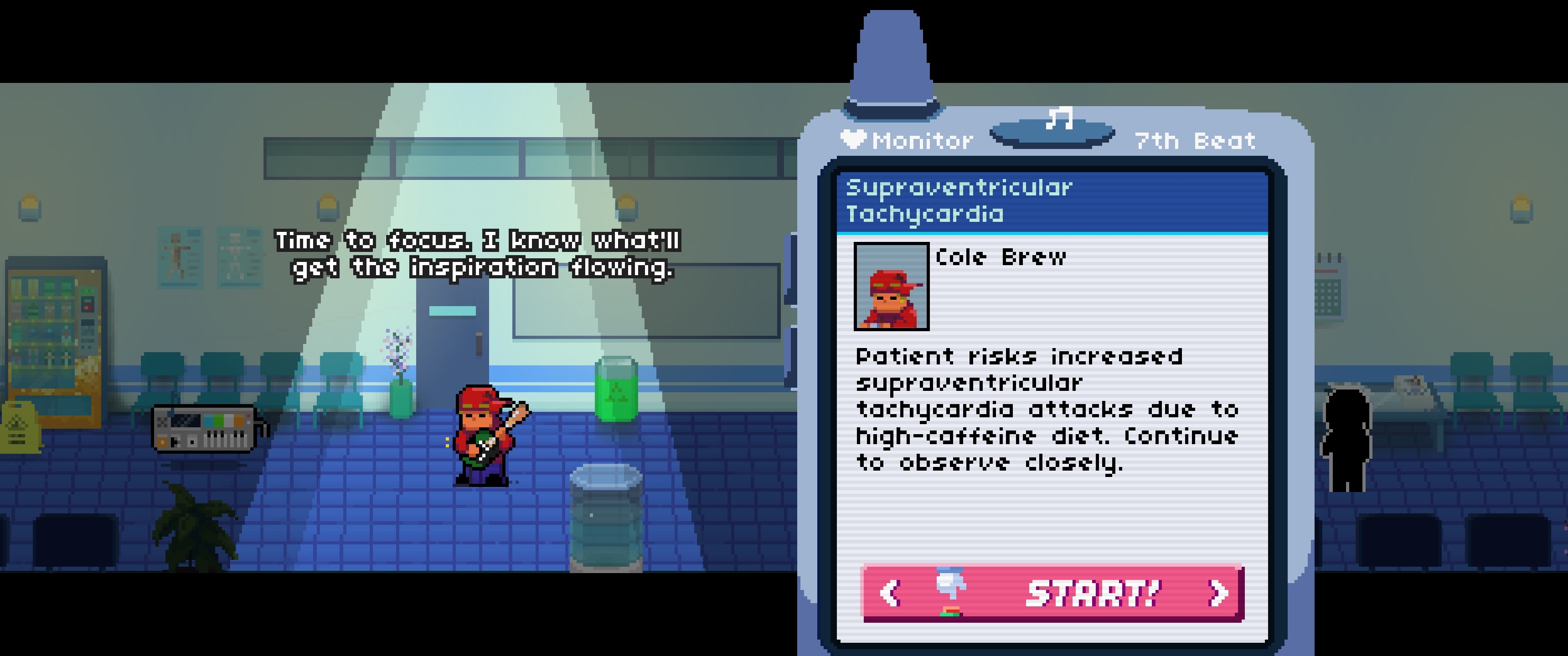
The setup for the game’s premise is something like this : a strange virus called Connectifia Abortus that causes cardiac illness has manifested in Middlesea Hospital and you are an intern tasked with treating it through a novel new initiative called the Rhythm Doctor Program. You as the intern appear on screen as a disembodied arm that taps a button in time with the beat. They are actually not kidding when they describe this as a one-button game, you tap the spacebar with the beat and that’s your entire method of action upon the game world (it’s actually played for laughs when characters ask questions to the intern and then realize you cannot reply). At first you’ll tap strictly on the 7th beat of a phrase, but as the story progresses it steadily adds more complexity. Some patients will manifest swing beats, others will need you to tap on the second beat of a two-beat pattern, some feature freeze beats where the rhythm shows a 2 or 3 beat pattern which you then tap on the last beat when that rhythm repeats, so on and so forth. Furthermore, the game often has you treating more than one patient at a time, each of whom has their own specific beat pattern to tap along to at various parts of a musical phrase. The complexity adds up fast, and the game to its credit also features some nice visual glitz and effects that adds to the overall experience.
When it works it’s a really great experience; you can kind of zone out and feel where your button press should fall while enjoying the show on screen. Where it starts to fall apart, I think, is later in the game (around late Act 5 through the Finale) where in order to add challenge it starts to layer (in my opinion) too many of these elements at once. Juggling three or more patients with completely different beat patterns starts to trigger some real cognitive overload, and even a music game enthusiast like myself ended up saying “I’m not sure this is fun anymore,” flipping it to the easiest difficulty, and finishing the last few story levels like that. The real achilles heel of the single-button setup is that adding difficulty necessitates this kind of stacking of differing rhythms and cognitive juggling and eventually for me it just got to be too overwhelming. The game introduces new beat patterns and variations so frequently that toward the end I just started to groan when inevitably the tutorial section came up after selecting a level.
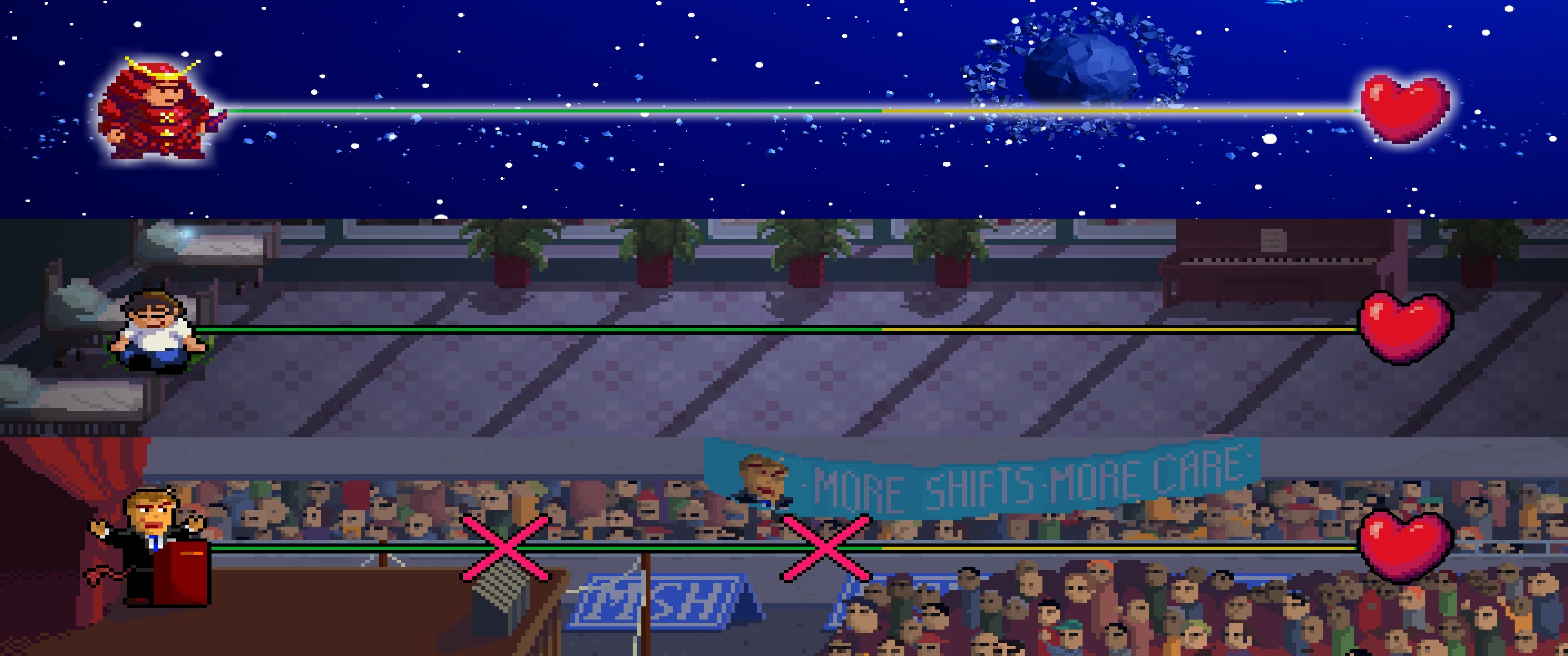
This may not be your experience; Rhythm Doctor does in fact have lots of favorable reviews on Steam and there are many other aspects of the game that work such as the strong, earnest character writing and generally good to excellent original music. It’s enough for me to still give this a recommendation star despite my obvious issues with it. Looking at Steam achievements though, only 8.1% of players at the time of this writing have actually finished the story finale so it makes me wonder if I’m not as alone in my opinion as I might think. It’s worth mentioning that the game has a custom level editor and Steam workshop support which could add a ton of replayability if it indeed ends up being a hit for you. Maybe check it out, if you like rhythm games.